
01 · Air purification & treatment
Electrostatic Filters
High-efficiency precipitators for grease, smoke, and sub-micron aerosols.
Overview
What it does
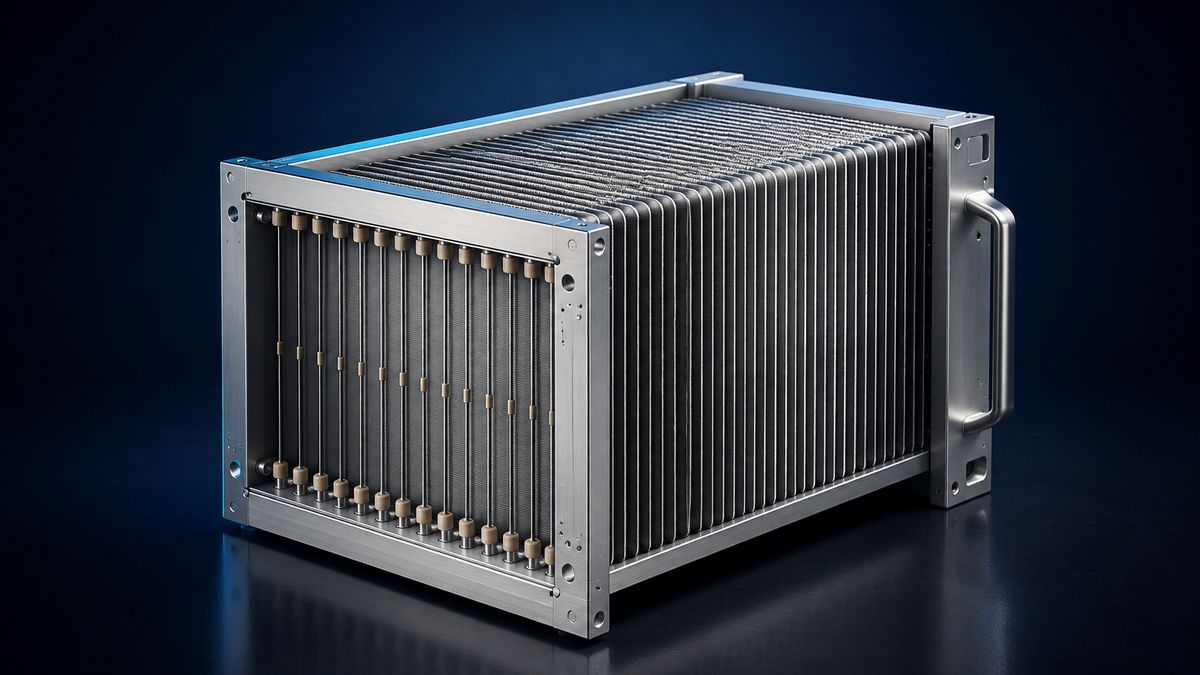
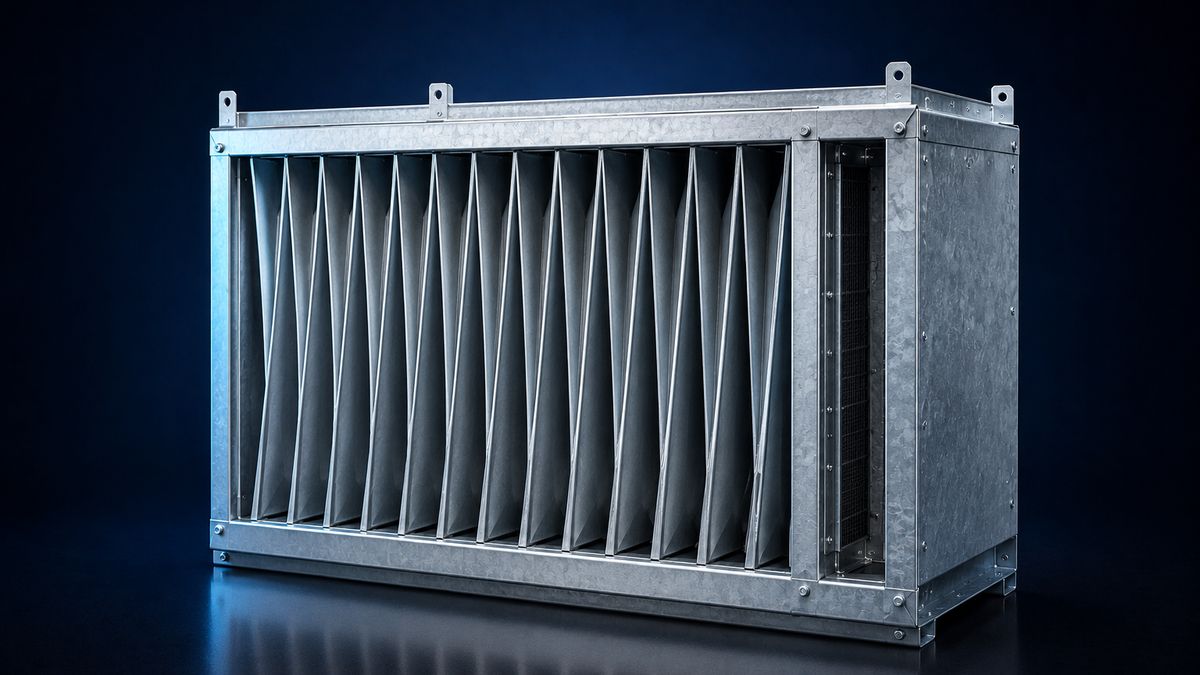
Flow Dynamics supplies electrostatic precipitators (ESPs) across the UAE for kitchen exhaust and industrial fume applications. ESPs are the workhorse stage inside any commercial kitchen ecology unit, but they are also specified as standalone cells for welding fume extraction, laser-cutter exhaust, and oil-mist capture on machining centres. An ESP captures particles too fine for conventional mechanical filters, runs with minimal pressure drop, and uses washable aluminium cells instead of disposable media, which makes the running cost substantially lower than equivalent bag-filter solutions.
How it works
The working principle
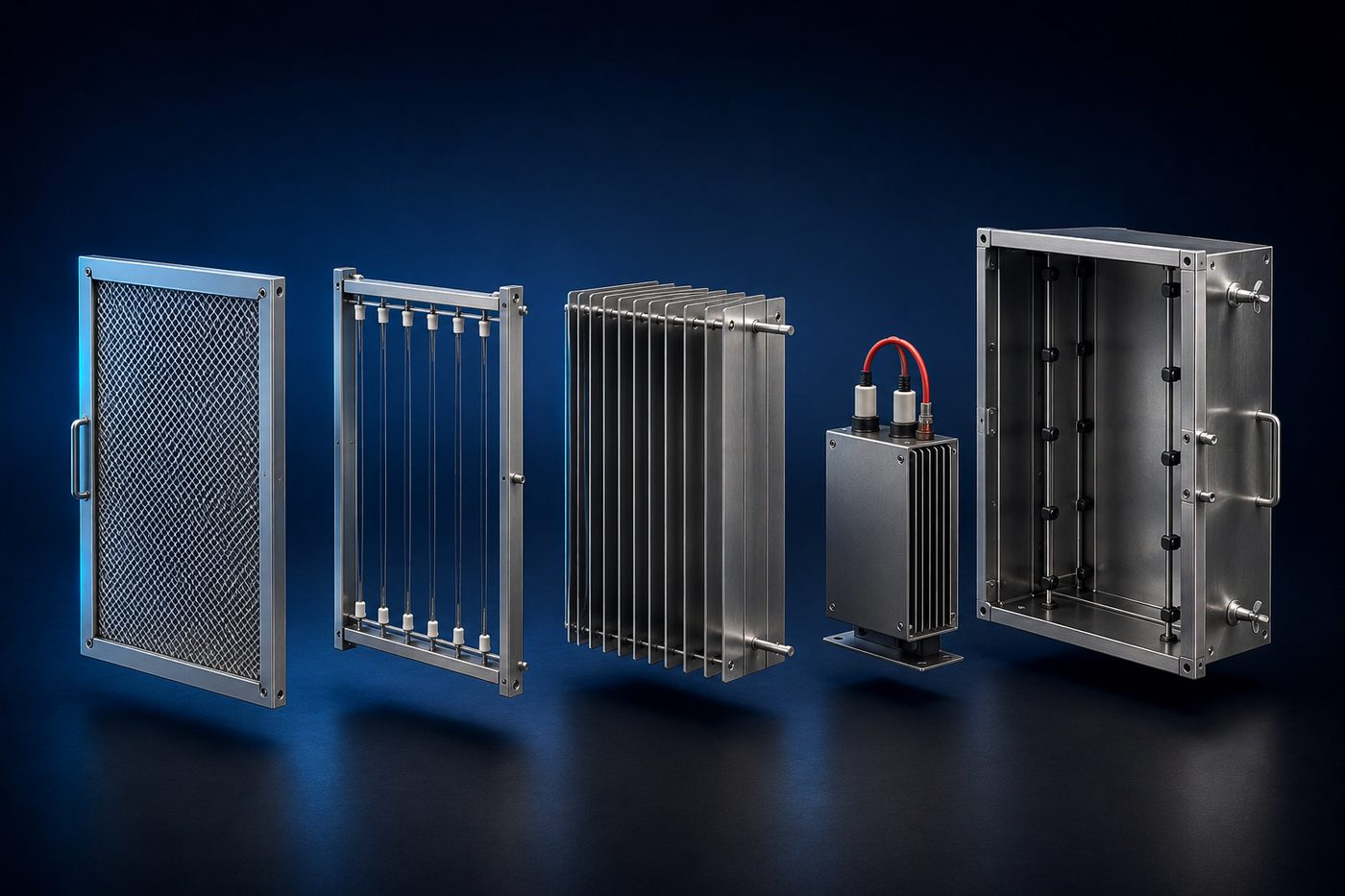
Incoming air first passes a pre-filter that removes lint and coarse dust. It then enters the ionizer section, where a tungsten or stainless wire held at roughly 10 kV positively charges every particle that passes. Immediately downstream, a stack of parallel aluminium collector plates alternates between earthed and biased polarity, every charged particle is pulled out of the airstream onto the nearest plate. The cells are periodically removed, washed, dried, and refitted. A high-voltage power supply with arc protection manages the field, and an on-board monitor flags shorted cells.
Applications
Where it's used
Typical installations across the UAE and wider Gulf include:
- Commercial kitchen exhaust as part of an ecology unit
- Welding and soldering fume extraction
- Oil-mist capture on CNC and machining centres
- Print shops and packaging lines
- Restaurant rooftop discharge treatment
- Pharmaceutical process ventilation
Specifications
Technical data
Indicative ranges, exact specifications are confirmed per project on selection.
| Airflow per cell | 1,500 – 3,500 m³/h |
|---|---|
| Particle efficiency | >95% at 0.3–1 μm |
| Cell voltage | 10–12 kV DC ionizer / 5–6 kV collector |
| Pressure drop | 80–120 Pa across cell |
| Cleaning | Washable aluminium cells, ~monthly |
| Protection rating | IP54 cabinet standard |
 RYDAIR · Singapore Flow Dynamics supplies equipment from this manufacturer. We do not act as authorised representative unless explicitly stated in a specific project supply agreement.
 Component teardown
Inside the machine.
Every component, taken apart. Select a marker to identify each part, or open the full teardown.
FAQ
Common questions
ESP or bag filters, which costs less to run?
An ESP uses washable aluminium cells instead of disposable media, so there is no recurring filter purchase and the pressure drop stays low. For continuous greasy or oily airstreams the running cost is substantially lower than an equivalent bag-filter bank.
How many ESP cells does my exhaust need?
Send us the application, airflow or demand figures, and any consultant specification. Our engineers reply with a defended selection, datasheets and submittal documentation. Sizing is always confirmed by an engineer, never by a web calculator.
How are ESP cells cleaned?
Cells slide out of the cabinet and are washed in a soak tank or heavy-duty washer, dried and refitted, typically monthly for a busy kitchen. The power supply monitors the field and flags any shorted cell.
You may also be interested in
Complementary products often specified alongside Electrostatic Filters.
Request a quotation.
Our engineering team can size Electrostatic Filters for your specific project and provide full datasheets on request.