 FLOW
FLOWIndirect hot-water storage
Hot-Water Calorifiers
A calorifier stores domestic hot water and receives heat from an external source through a coil or exchanger. Selection aligns demand, source conditions, storage, water quality and plant-room access.

Manufacturers
 Zenith
 API Energy
Applications
Storage and heat input must be selected together.
The useful capacity of a calorifier system depends on how hot water is drawn, how heat is transferred back into storage and how the system is controlled. The vessel cannot be selected responsibly without the source-side and domestic-water-side conditions.
Hotels and guest accommodation
Stored hot water planned around changing occupancy, simultaneous demand and the central plant strategy.
Residential developments
Central hot-water storage serving grouped dwellings where the demand profile is defined by the project.
Healthcare and institutional buildings
Indirect storage coordinated with the building hot-water design, circulation and maintenance approach.
Commercial and leisure facilities
Hot-water storage for changing-use areas, wash facilities and other scheduled domestic-water loads.
How it works
Heat crosses a barrier into stored water.
A separate heat-source circuit transfers energy through a coil or heat exchanger without mixing directly with the stored domestic water. Controls respond to the storage condition and call for heat according to the project sequence.
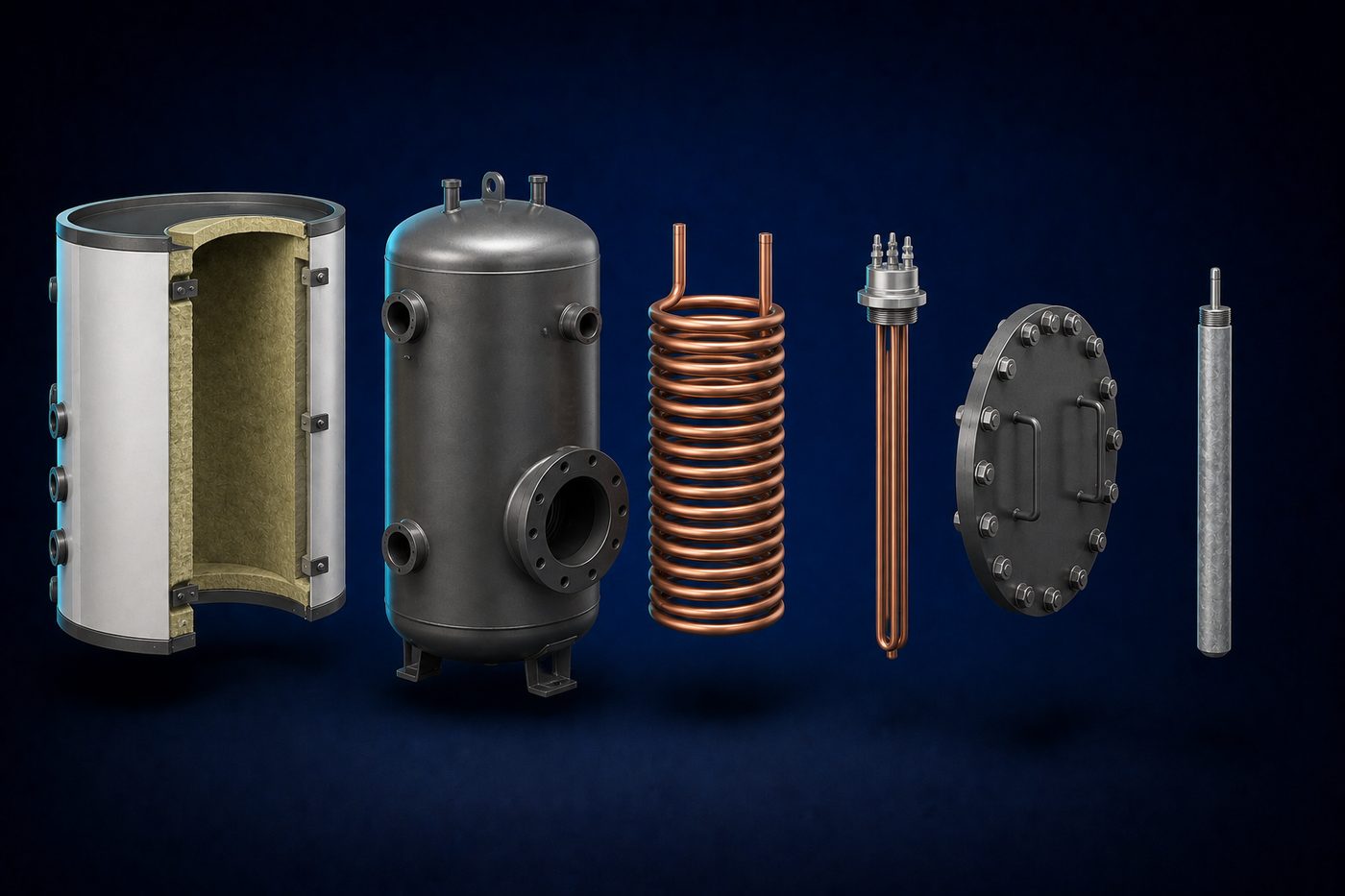
- 01
Heat arrives from the source
The primary circuit carries available heat from the project plant to the calorifier arrangement.
- 02
Energy transfers to the water
A coil or external exchanger separates the source circuit from the domestic-water side.
- 03
Hot water is stored
The vessel holds heated water so the system can respond to the planned demand pattern.
- 04
Controls restore storage
Sensors, valves and pumps operate according to the coordinated project sequence.
Describe demand and the available heat source.
Calorifier selection is a balance between stored volume, heat-transfer duty and recovery strategy. Final vessel construction and accessories follow the project water and plant requirements.
01Hot-water demand profile
Provide fixture or consumption data, occupancy pattern and periods of coincident demand.
02Heat-source conditions
State the source type, available temperatures, flow conditions and operating schedule.
03Domestic-water basis
Share incoming-water conditions, design temperatures, pressure basis and water-quality information.
04Plant-room envelope
Confirm orientation, route to position, floor loading, connection zones and service clearances.
05Controls and circulation
Provide the recirculation approach, control narrative and interfaces with the wider hot-water system.
Plan your enquiry
Protect access to the vessel and its interfaces.
The final installation should allow safe positioning, connection, inspection and future service. Maintenance needs vary with vessel construction, water conditions and the selected heat-transfer arrangement.